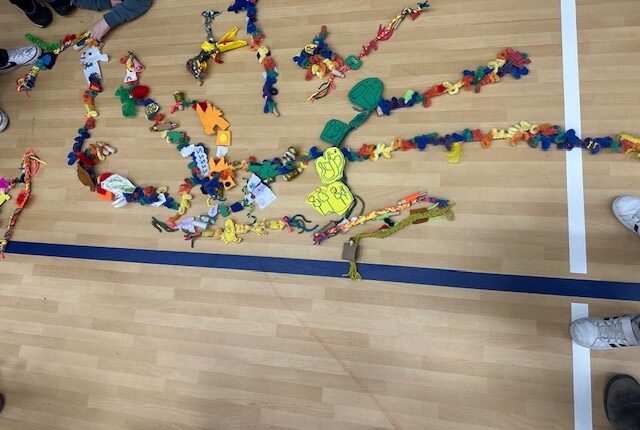
We learnt about Story Vines after reading Sometimes Reading is Hard by Robin Bright, pages 91-92. Story Vines are created by first braiding enough string together to make about an arm’s length long thick braid, which you can then use different media to create different parts of a story that would help you retell it later. This can be used to help with students comprehension of a story as well as oral fluency. Bright had learned about them from Marlene McKay.
According to Marlene, story vines are based on an old African tradition of storytelling and can be used to develop language and support reading and writing across the curriculum. -page 91, Sometimes Reading is Hard
The fact that they are rooted in African culutre but they are also truly so adaptable to many different subjects and grades. We even did them in a thrid year undergrad class, grade 2/3 class and Kindergarten class. Getting to make our own first was such a great way to prepare for going in with our grade 2/3’s. It was so much fun choosing our own books that we would get to bring to show our grade 2/3’s so they could get an idea of what we were doing.
Making Story Vines with Students
When we got to make them with students, it was super interesting to see which parts of the story they would pick up that I would have never noticed. We did this activity at our local bookstore, Huckleberry Books, and we read The Paper Bag Princess by Robert Munsch, on Paper Bag Princess Day. One of the students in my group noticed that the dragon was wearing a bib because he was getting ready to eat the prince, and that it was a detail that should be included when we create our story vines. We first let our students plan out what details they wanted to make for the story vine so that they had an idea of what they wanted to make before we collected materials. I think it could have been useful if we had students a sheet to fill in and not just a piece pf blank paper so that they would know the sequence of the story they were following with their planning. I found that students were remembering details from the beginning and the end, but forgot some of the in between, so I think a sequenced handout would be useful. The students had a blast getting to create their vines and add their own touches. I love to see how every student is read the same book, given the same instructions, and the same material and produces different details to help them retell the story and create such different vines. After we created the story vines, we got to meet the same students the next day at their school, and we got to help them show off their story vines to the Kindergarten classes at their school.
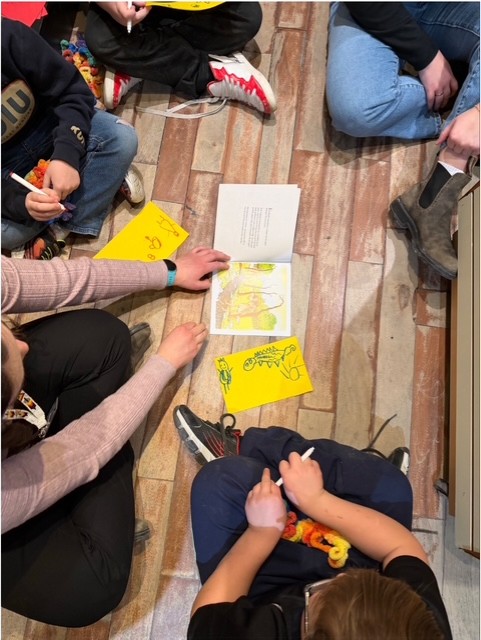
Showing the Kindergarteners
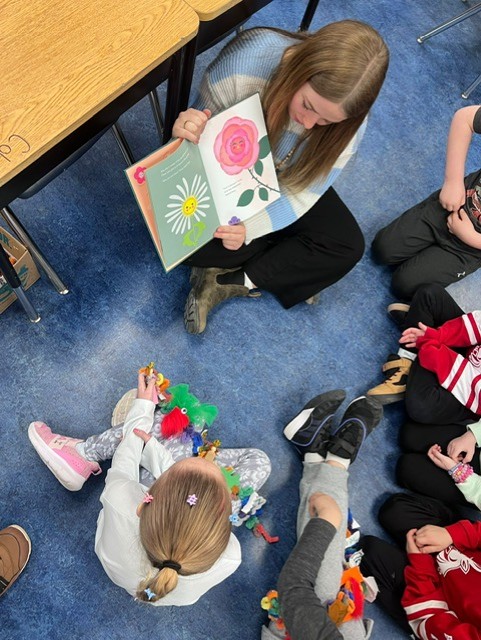
The next morning, when we came to see the grade 2/3’s again, we reread the story The Paper Bag Princess before they got their story vines. Once they had their story vines, they got put in pairs and were paired with a group of four Kindergarten students, and then they would have one to two UVIC students with them. When we all got together as a group, we sat down and introduced ourselves to each other, then we made sure the story was fresh in the Kindergartens’ minds, and the grade 2/3’s took over and shared all about their story vines. Our first student was super extroverted and was so excited to share their story vine, so they went first. Our second student was more introverted, so we let that student just explain how she made her different elements on her story vine because that was something she was more comfortable with. Once our grade 2/3’s were done sharing about their story vines, we spent some time doing read-alouds of a couple of different books, which the students loved, and we did lots of pausing and questions while reading the books. This was definitely my favourite part of the activity, getting to watch students share what they made and be proud of it, as well as just spending time getting to know some students.
Curriculum Connections
For grades 2 and 3, this activity works with the same big idea that language and story can be a source of creativity and joy by having students explore the Paper Bag Princess by creating story vines. They also both use the content of oral language strategies because the students were presenting their story vines to the Kindergartens, but they work with different curriculum competencies. For grade 2, it explores oral storytelling processes, and in grade 3, it is the use of oral storytelling processes. So all in all very similar, but one looks more at just getting used to it in grade 2 and exploring it as a newer idea and in grade 3 it’s more of an expectation that they are making a conscious effort to use oral storytelling processes.
Sorry, but comments are not enabled on this site.