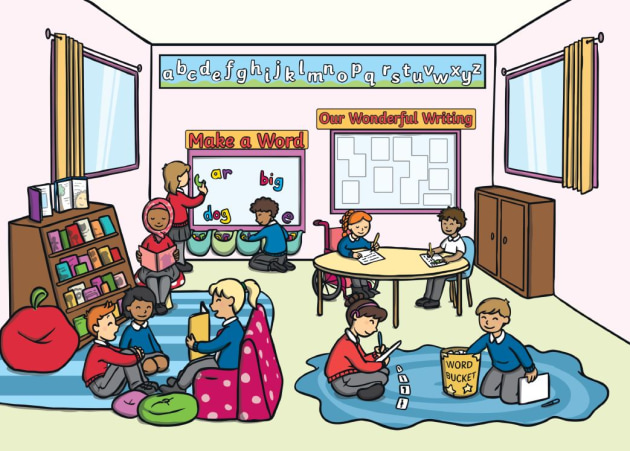
I did a literacy station in a grade 1 class, focused on the magic E. Which is when you can’t hear the E at the end of a word but it makes the vowel the middle say its name. We got to be there for about an hour and we had four stations in each room. I created my station to be a word search that had different lengths of words between four and five letters. For each group that came I started off the station the same way, I greeted them told them my name and then asked for theirs. I would then ask if they had been working on their magic E and they got so excited to tell me about the work they had been doing. After that I would explain my station and students could start.
When creating my word search I was trying to think about how to stretch the activity for my quick finishers but in a way that wouldn’t stress out my later finishers so that they would feel like they were behind. I decided to scramble the word plate a little bit so that my students would have an extra challenge. In the word bank it was spelled properly so that if they didn’t know the spelling of plate they would have it. I spelt the word elatp, so that my students had two ways to fix it: one was to switch the p and the e or they could switch the l and t so that the word was spelt backwards in the word search. I felt like this was a great challenge for the early finishers because they thought it was silly and fun to correct the sheet. It also didn’t make my students who took longer stress out over the fact that they were still finding words.
I found that it was also helpful that at the key for the word search i put images with the words so students had a visual cue of what the word was if they hadn’t learnt it yet or it was something that a struggling reader could use to guide them back to what word they are using. This is definitely something I would use again with another group for this word. I even found some of my students would be able to get through it all so I came us with having them choose one or two of the words for the word bank and write a sentence on the back and draw a picture to match.
I really enjoyed getting to see literacy stations in action and seeing how my students were able to use all the different modifications and extensions I had put in place with the sheet. I definitely think literacy stations is something I would use in my own class one day. I don’t know though how I would bring this into my practicum in April with grade 5.
With this station, if I were creating a lesson plan for a lesson with literacy stations about magic E, I would first align it with the BC grade 1 English Language Arts Curriculum. For the big idea, I think this lesson works with playing with language, which helps us discover how language works because we are creating stations that are fun and allow students to play with and explore magic E. For curricular competency, I think it works with the use of foundational concepts of print, oral, and visual texts. When students are working with magic E, they are learning how it works in words to make different sounds with the other letters around it. They are also using the pictures that were included in the word bank to help them figure out what the words are. Lastly, the content that I think aligns with language features, structures, and conventions: phonemic and phonological awareness.
After doing this in-situ I was reflecting on what BC Professional Teacher Standards I would have been using when I was teaching this day. The main one that came into my mind was number 3: Teachers understand and apply student growth and development. When I created my word search, I was really trying to think about how the students I could be working with could be at all different levels. This understanding of how students’ learning and skills are at different levels allowed me to adapt to my students’ needs when we were all working together on the word search at different paces.
Sorry, but comments are not enabled on this site.