
For the past three weeks, my partner Kenna and I have been going into a grade 4 classroom and reading the book The Animal People Choose a Leader by Richard Wagamese. We broke the book into three different parts to read each lesson, and we also created different activities to go along with the different parts of the book. Our activities went along with the three different sections we broke the book up into, based on what we thought made strong learning moments.
For our first section, we paused at the moment where the race begins. We used this as a springboard to get our students to explore a time when they were taking part in a competition and how they felt in the moments leading up to the competition. We had them then take the feelings they felt and try to empathize with the animals in the book who were about to start the race, and what might be going through their heads. Then, based on their brainstorm of what the animals thought, we had them create tableaus based on those emotions, with one person being the narrator for them. It worked really well. The students at first did ask if they had to do it, but as they got into character and got to creating their tableaus, they seemed to take an interest in it. Some students did get a little silly when presenting, but with drama in a grade four class, that is to be expected. One thing I think I would change is doing a pair share with their friends about what they felt before they competed.
Our second activity was based on when the animals took off on the race up to the point where the first animal got stuck, and Waabooz helped him through the brush. We had students brainstorm a time that they helped someone or that they received help from someone. From there, we gave students time to complete the worksheet, where they drew a picture and wrote a few sentences about that moment and how it made them feel. Once they were finished with the worksheet, we left time at the end for the students to share. Although I wanted to hear all the students’ examples, I don’t think they were all comfortable sharing out, so instead of asking who wants to share, I would probably do a pair and share instead. One thing that definitely needed more front-loading for this activity is brainstorming different ways that we can help and be helped by people, because that seemed like something students needed clarity on. But all in all, I think this is a great activity. Another thing that I think is that this could be really stretched to a bigger activity with peer editing and revising of the writing work. Then, giving them longer to work on the art pieces so that they could all be compiled into a classbook about helping each other and being helped.
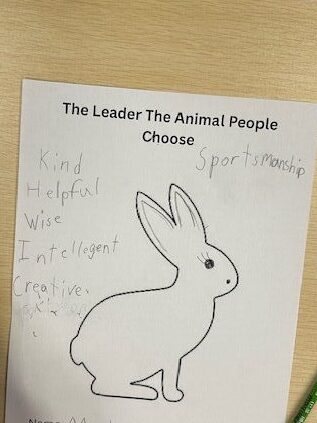
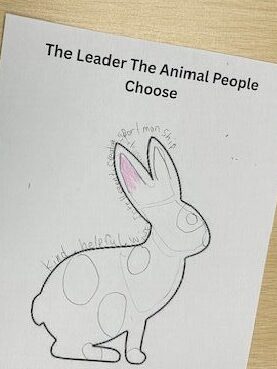
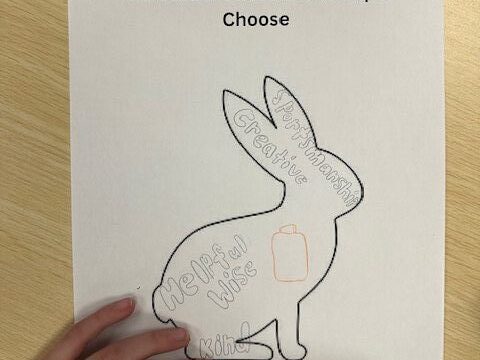
On our last day with the class, we finished the book and saw Waabooz help all the animals, and in the end, they all needed the support of each other. We got to see how Waabooz’s commitment to finishing the race allowed her to learn more about leadership and what comes with the territory, and not just the definition of what it is. After finishing reading, we spent time doing a yarn web activity to show how we are all connected, and a leader needs the people they lead just as much as the people need their leader. Then we went into a brainstorm and worksheet about what characteristics we think make up a good leader, and then the students wrote them on their worksheet and coloured in Waabooz. This was a great conclusion activity that I really think impacted the students and made them see the bigger picture of the story. Below are some student examples of our final worksheet. (They were collected with student’s permission)
Over the past three weeks, we’ve gone in we have been able to develop relationships with students, the Education Assistants, and the classroom teacher so that the students were supported through the activity. I really loved this book and how it was chunked up. I know I really think the moment where Waabooz stops to rest at the lakeside is a moment I would want to pause at next time, just because it offers such an amazing starting point for sit spots and practicing gratitude when out in nature. I also know that I wouldn’t want to read this book in one sitting with any grade, just because it is long, and there are so many amazing lessons in this book. I am definitely wondering if I can find a way to bring this book into my practicum so that I can continue to work with it.
When it came to organizing my thoughts and activities for this mini unit, I used the Read Aloud template on page 102 from Read Alouds for All Learners by Molly Ness (2024) to help me organize my read aloud. While exploring and working with this template, I definitely found it a little difficult and hard to navigate at times. When working through the “Funds of Knowledge” piece, I struggled to come up with ideas on what should go in that box. I think that the template overall had too many boxes, so my work felt unnaturally broken up. Although one thing I did like about it was the section about Social and Emotional learning because the book The Animal People Choose A Leader really is focused on teaching social and emotional skills. Overall, though I would probably choose to use the UVic unit or lesson template or something else I would create on my own. Below you will find the template I used.
Sorry, but comments are not enabled on this site.